
The Old Ways and the Holy Ways: Part 3

Updated: Sep 9
Finding My Roots Through Sicilian-American Folk Catholicism
A SEVEN-PART SERIES
Part III
From Cefalù to Louisiana
The Curreri Family Story
My connection to Sicilian-American Folk Catholicism is not only cultural; it is personal. These traditions were carried across the ocean by my own ancestors, who left Sicily and built new lives in Louisiana and the Mississippi Delta. When I explore these traditions, I am not only studying the culture they came from. I am looking for traces of the people who carried those traditions before me.
The story of my family begins in the coastal town of Cefalù, in the province of Palermo, Sicily. A historic community on the northern coast of the island, Cefalù is known for its Norman cathedral, winding medieval streets, and long history as a Mediterranean coastal settlement.
Like many Sicilian communities, Cefalù was a place where family, Catholicism, local traditions, and community life were closely connected (Norwich, 1989; Carroll, 1992).
It was in this world of seaside villages, Catholic devotion, and close family ties that my own family story began.

One of the earliest documented ancestors in this branch of my family is Filippo Curreri, born on October 14, 1827, in Cefalù, Sicily. His parents were Francesco Curreri, born in 1794, and Maria Cesare, also born in 1794.
In Sicily, the family name was Curreri, pronounced within my family as “koo-REH-ree.” After immigration, the surname eventually became recorded as Correro, pronounced within my family as “Co-RAIR-oh.” I cannot establish exactly why the spelling changed.
Italian surnames could vary in spelling across historical records, and immigrant names were sometimes recorded differently as families moved between languages, communities, and recordkeeping systems (De Felice, 1986).
For my family, the change from Curreri to Correro became part of the story of immigration itself.
Family records place Filippo and his family at 38 Via Corte, now known as Via Bordonaro, in the heart of Cefalù. The initials “FC” are still carved into the entrance portal of the home.

That detail is meaningful to me because it gives me something tangible to connect to.
I can look at a place in Cefalù and know that my family was there.
On October 1, 1852, Filippo married Concetta Maria Esposita Intesa Carnaggio in Cefalù, and they had six children together.
Concetta was born on December 10, 1832, and was named in honor of the Immaculate Conception of Mary. Her parents are unknown. She was relinquished at birth to the Nuns of the Badiola at the “Refugium” orphanage, where she was raised and educated.
Names and Family Memory
The tradition of honoring those who came before continued throughout my own family.
Names such as Filippo (Philip/Phil), Giuseppe (Joseph/Joe), Antonio (Anthony), Giovanni (John), Francesco (Francis/Frank), Brossie (Blaise), Maria (Mary), and Concetta appear throughout multiple generations, reflecting the importance placed on honoring those who came before.
In Italian and Sicilian families, naming children after grandparents was a longstanding tradition, particularly in southern Italy (Orsi, 1985; Nelli, 1983).
My own family continued this tradition, with the name Filippo being carried forward through later generations, eventually becoming Philip in American records. Similarly, Giuseppe was later adapted to Joseph in American records, continuing that connection between generations. Names became a way of honoring grandparents and preserving family connections (Orsi, 1985; Nelli, 1983).
One of Filippo and Concetta’s children was Giuseppe Curreri (Correro), born on May 15, 1868, in Cefalù, Sicily. Giuseppe immigrated to the United States in 1884, arriving in New Orleans, where he was known in American records as Joe Correro. His change from Giuseppe to Joe reflects the common experience of Italian immigrants whose names were adapted within English-speaking communities.
Another of Filippo and Concetta’s sons, Frank Correro, came to the United States in 1882. Fifteen years later, in June 1897, Frank brought his parents, Filippo and Concetta, to America, where they settled in New Orleans.
Giuseppe married Mary Concetta Grace Serio on July 24, 1886, in New Orleans, Louisiana. Mary was also born in Cefalù, Sicily, on July 26, 1875.

Giuseppe’s immigration was part of the larger wave of Sicilian migration to the United States during the late nineteenth century. Like many Sicilian immigrants, his journey became connected to New Orleans, which developed one of the largest Sicilian-American communities in the Gulf South (Maselli & Candeloro, 2004).
The fact that Giuseppe and Mary Grace both came from Cefalù is meaningful to me. It shows how connections to the same village could continue even after people crossed an ocean. Family, language, traditions, and Catholic devotion could still connect immigrants to the places they had left behind.
Their son, Philip Leo Correro, was born on January 23, 1893, in Gunnison, Bolivar County, Mississippi. Census records later place the family in Indianola, where Philip worked as a clerk before marrying Salvatora Leona Perari, later known as Dorothy Salvatora Perari, in New Orleans on February 2, 1913.
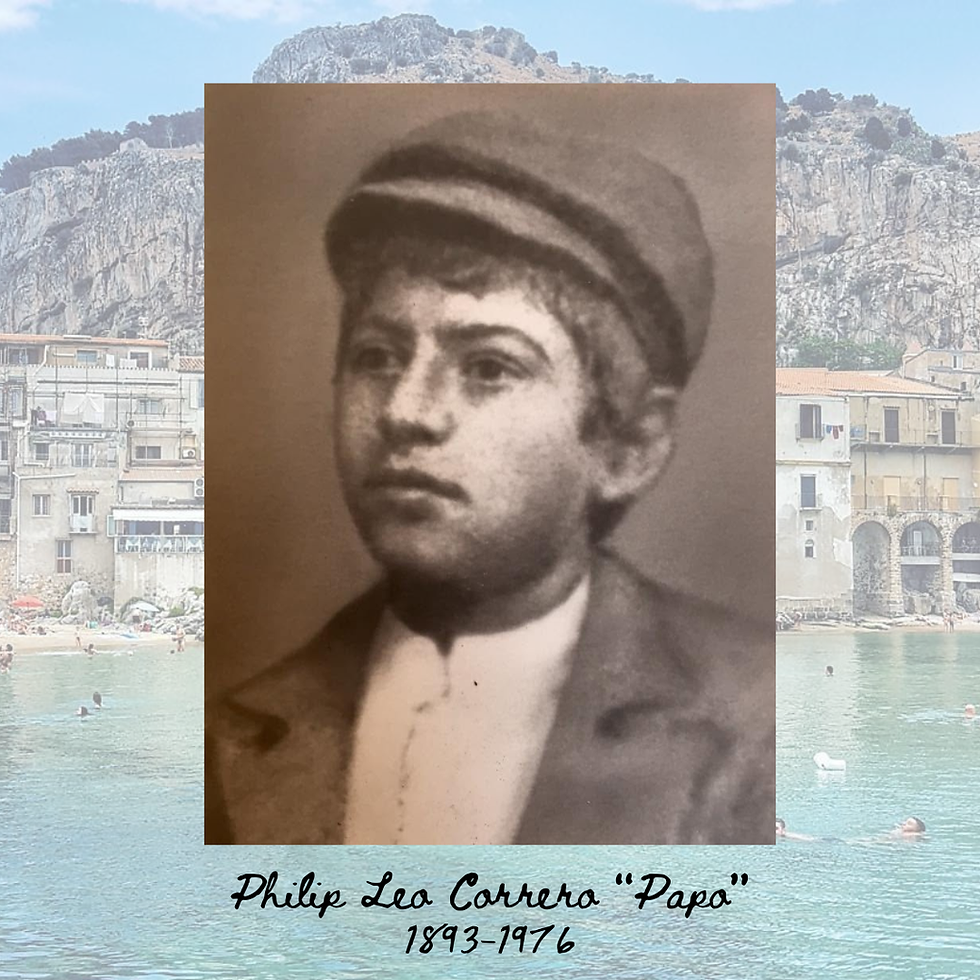
In our family, Philip Leo was called Papo, and Dorothy Salvatora was called Mamo. Those are the names I grew up knowing them by.

New Orleans and the Mississippi Delta
Sicilian and Italian immigrants became part of communities throughout the Mississippi Delta, building lives around family, agriculture, commerce, and cultural traditions (Canonici, 2013).

New Orleans became one of the most important centers of Sicilian immigration in the United States during the nineteenth and early twentieth centuries. Sicilian immigrants built neighborhoods, businesses, churches, and family networks where traditions from Sicily could continue while adapting to life in Louisiana (Maselli & Candeloro, 2004; Nystrom, 2018).

My family became part of this larger Sicilian community.
By the early twentieth century, members of the Correro family were living and working in the Mississippi Delta. One family photograph from around 1909 gives a glimpse into their lives in Greenville, Mississippi, where the family lived above Sam Correro’s Market on South Walnut Street.
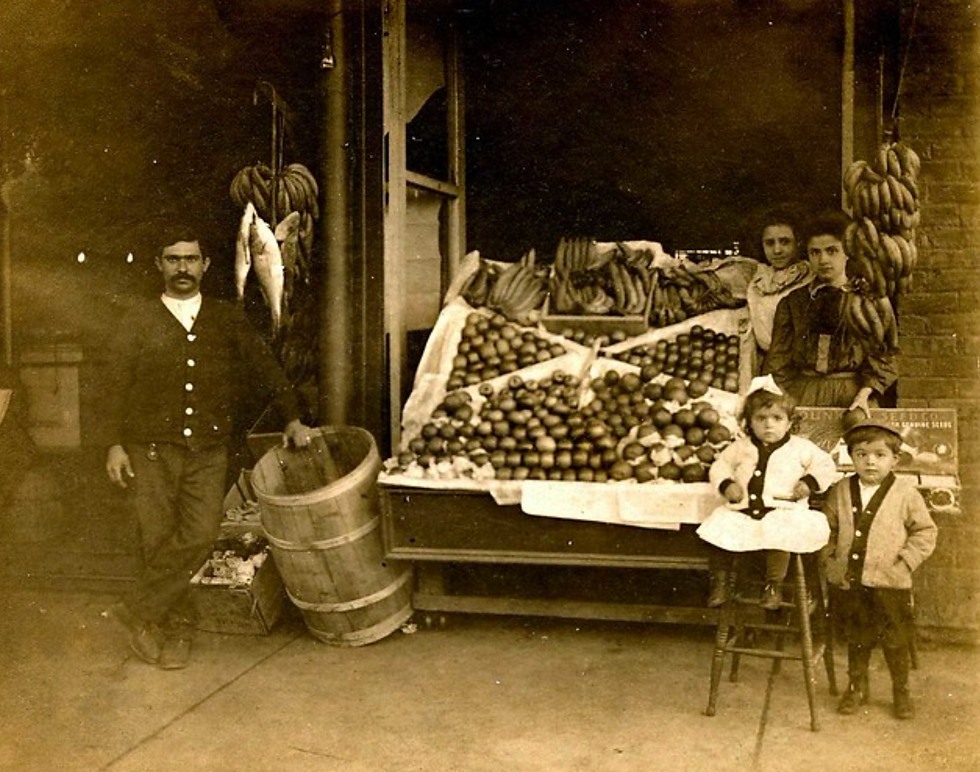
Living above the store were Frank and Dominica Correro, their daughter Mary, their son Sam and his wife Mary Grace, and their two children, Lee and Minnie. Also living with them were Joseph Correro, his wife Alice, and their son Salvatore.
One reason I feel such a strong connection between Sicily and Louisiana is that both places are crossroads.
Sicily has been shaped by centuries of migration and cultural exchange. Louisiana, too, developed through the influence of French, Spanish, African, Caribbean, Indigenous, and Italian communities. Both places have strong traditions of food, family, Catholicism, and cultural practices shaped by the people who arrived there (Norwich, 1989).
The traditions my ancestors brought from Sicily did not necessarily disappear when they arrived in America.
They adapted.
Saints, prayers, family celebrations, religious objects, food traditions, and feast days could all become part of life in their new communities. Italian immigrants often maintained cultural and religious traditions while adapting them to their new environments (Orsi, 1985; Maselli & Candeloro, 2004).
The transformation of my family’s surname from Curreri to Correro is part of that same process. I cannot establish exactly when or why the spelling changed, but it shows how a family name could change as it moved between languages and recordkeeping systems while still belonging to the same family.
Philip and Dorothy
Philip Leo Correro and Dorothy Salvatora Perari were married in New Orleans on February 2, 1913.

The civil marriage record documents their marriage in Orleans Parish, but the church where the ceremony took place has not yet been confirmed through surviving sacramental records.

Family tradition has long held that Philip and Dorothy were married at the Cathedral-Basilica of Saint Louis King of France in Jackson Square. Dorothy’s family lived at 1138 Chartres Street in the French Quarter, only a short walk from the cathedral, so it is easy to understand how that tradition became part of our family story.

Until a parish marriage register or other primary source confirms the location, the exact church where they exchanged their vows remains uncertain.
I think this distinction is important when telling my family’s story. There are things I can document and things that have been passed down through family tradition. Sometimes the two overlap, and sometimes they do not. I do not want to turn a family story into a fact simply because I want it to be true.
What I do know is that Philip and Dorothy were married in New Orleans, and Catholicism was an important part of the world in which they lived. For Italian immigrant communities, churches could become centers of community life where faith, family, and traditions came together (Orsi, 1985; Maselli & Candeloro, 2004). For families like mine, they were places where faith, family, and memory met.

The Perari Family and the French Quarter
My great-great-grandmother Dorothy Salvatora Perari, whom we called Mamo, was born on November 25, 1896, in New Orleans. Her parents were Domenico Perari and Nunzia Brocata.
Her birth record places the family at 1129 Decatur Street in the French Quarter, and lists her father, Domenico, as a seaman. That detail confirmed something I had heard throughout my family: Domenico was a sailor. Family stories recall him coming home from the ships, crossing the levee, and making his way through the French Market to his family’s home.

Family tradition also holds that Dorothy was baptized at the Cathedral-Basilica of Saint Louis King of France in Jackson Square. With her family living so close by, it is easy for me to picture the cathedral as part of her childhood world.
I often imagine what that neighborhood looked like when Dorothy was growing up there.
I picture the ships along the Mississippi River, the sounds of the French Market, the families living and working throughout the French Quarter, and the cathedral standing in Jackson Square.
I imagine Dorothy as a child growing up there, surrounded by Catholic churches, immigrant families, and the traditions her parents brought with them from Sicily.

Philip and Dorothy’s son, Joseph Anthony Correro, was my great-grandfather. He was born on February 26, 1915, in Indianola, Mississippi. Joseph was the oldest of ten children and grew up in Drew, Mississippi, where his father managed the local ice plant. The family eventually moved to Cleveland, Mississippi, where Joseph later worked as a postman.
Joseph married Willie Ruth Houston in 1936, and they had six children. One of their sons was Philip Oliver Correro, my grandpa. Joseph and Willie Ruth were married in Cleveland, and I believe they may have eloped.

Phil was born on August 24, 1937, in Cleveland, Mississippi. He was the oldest of Joseph and Willie Ruth’s six children. His sisters were Trish, Pam, and Dot, and his brothers were Jody and Quinn. Trish, Pam, and Quinn have since passed away.
Phil was a member of Holy Spirit Catholic Church in Hernando, Mississippi, and the Fourth Degree Knights of Columbus. He also served for ten years in the United States Marine Corps, including as a captain during the Vietnam War.
After leaving the Marines, Phil spent the next 40 years working as a project engineer, builder, contractor, and draftsman.
He married Fran Kathryn White on February 3, 1959, at Our Lady of Victories Catholic Church in Cleveland, Mississippi. At the time, the church was still in its 1939 brick building. The building was damaged by an earthquake in 1967, and the parish later moved to a new location.
Phil and Fran had three children together and remained married for sixty-five years.
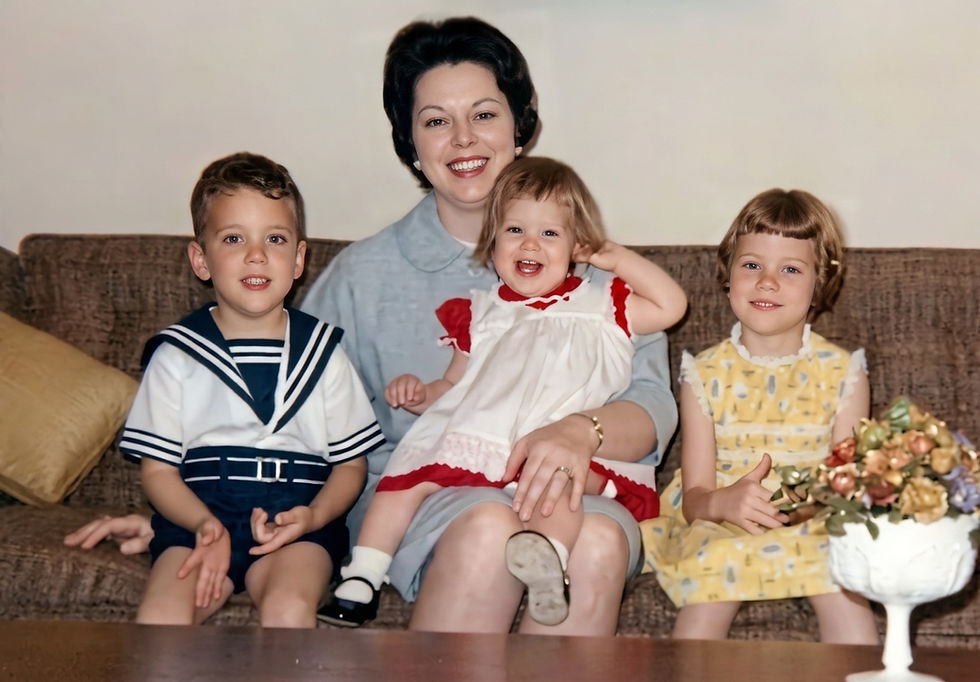
My father, Anthony “Andy” Nash Correro, was born on March 20, 1961, in Beaufort, South Carolina. He is a retired U.S. Air Force lieutenant colonel and B-52 pilot, as well as a retired captain for Southwest Airlines.

By the time we reach my dad, the family story has come a long way from Cefalù. Over four generations, my family went from Sicily to New Orleans and eventually into the Mississippi Delta. Tracing that history has also led me to think more deeply about the traditions my ancestors carried with them and how they continue to shape my own spiritual journey.
What is Documented and What is Remembered?
The more I research my family, the more I realize that genealogy can only tell me so much. I can find names, dates, places, and records, but I cannot always know what life was like for the people behind them.
That is part of why Folk Catholicism interests me. It gives me another way to understand the cultural and spiritual world my ancestors came from while still recognizing the difference between what I can document and what has been passed down through family stories.

_________
A Note on Sources
Because this essay is presented as a seven-part series, the complete reference list for sources cited throughout all seven parts will be included at the end of Part VII: Between the Old Ways and the Holy Ways.


Thank you so much for sharing this. My grandmother is Mary Correro Dantone. She was born in N.O. and baptize in the same church. I have her birth certificate. Again thank you, William Joseph Mosley. son of Catherine Rose Danrone