
The Old Ways and the Holy Ways: Part 2

Updated: Sep 27
Finding My Roots Through Sicilian-American Folk Catholicism
A SEVEN-PART SERIES
PART 2
An Island Between Worlds
My connection to Folk Catholicism is deeply connected to my Sicilian heritage. To understand the traditions I am drawn to, I first have to understand the place from which my family came.

Sicily is an island shaped by migration, cultural exchange, and centuries of layered history. Long before Catholicism became central to Sicilian identity, the island was already a crossroads of civilizations. Greeks, Romans, Byzantines, Arabs, Normans, and Spaniards all influenced Sicily’s culture, leaving behind traditions that continue to shape the island today (Norwich, 1989).
Because of this history, Sicily has always existed between worlds. Located at the center of the Mediterranean, the island has been influenced by Europe, North Africa, and the Middle East. These connections can be seen in Sicilian architecture, language, food, music, art, and religious traditions. Sicily’s identity was not created from one single influence, but from many cultures meeting and transforming one another over time.
As Christianity became established throughout Sicily, older customs and local traditions were often incorporated into a Catholic framework. Rather than simply disappearing, many practices were adapted and given new meanings through devotion to Christ, the Virgin Mary, and the saints. Over centuries, these traditions developed through prayers, feast days, pilgrimages, blessings, household rituals, and practices of protection (Carroll, 1992; De Martino, 1972).
Scholars of Italian popular religion have examined the relationship between official Church teachings and the ways communities practiced faith in their own homes and villages. In many Italian communities, the sacred was encountered not only through formal worship, but through relationships with saints, sacred places, healing traditions, miracles, and rituals woven into daily life (Carroll, 1992).
Families blessed their homes with holy water, prayed for protection from the malocchio (evil eye), lit candles before images of Christ and the saints, and carried rosaries or medals as signs of faith and protection. These objects were not simply decorative. They served as reminders of a spiritual relationship that existed within everyday life (Dundes, 1981; Carroll, 1992).
Feast days, processions, home altars, healing prayers, and blessings for crops, fishermen, travelers, and loved ones became part of the rhythm of Sicilian communities. These customs were not separate from Catholicism. They were expressions of how Catholic faith was lived by ordinary people (Carroll, 1992; De Martino, 1972).
When I imagine my own ancestors walking through the streets of Cefalù, I picture them surrounded by this world of devotion and tradition: church bells echoing through narrow streets, saints carried through village celebrations, candles burning before sacred images, and family prayers spoken in the language of generations before them.
This is the Sicily I am searching for. Not only the Sicily recorded in history books, but the Sicily carried through memory, ritual, and family traditions. It is the Sicily that crossed the ocean with my ancestors and continues to influence the way I understand faith, belonging, and identity.
Protection, Healing, and the Malocchio
One of the most recognizable traditions within Italian and Sicilian folk practices is the belief in and protection against the malocchio, or evil eye.
The malocchio refers to the belief that envy, jealousy, or harmful intention can bring misfortune, illness, or other forms of harm. Across different communities, families developed prayers, rituals, and protective customs intended to identify or counteract the effects of the evil eye (Dundes, 1981).
Although the malocchio is associated today with Italian and Sicilian traditions, the belief in the evil eye is much older than Italy itself. Beliefs surrounding the harmful gaze appear across the ancient Mediterranean and Near East, including Mesopotamia, Egypt, Greece, and Rome. Ancient communities developed prayers, amulets, images, and rituals intended to protect against this perceived source of harm (Dundes, 1981; Ogden, 1996; Pagliarulo, 2023).
One of the most striking surviving examples comes from Roman Antioch, in present-day Antakya, Turkey. A second-century CE mosaic from the so-called House of the Evil Eye depicts a large eye being attacked by weapons and animals, including a trident, sword, scorpion, snake, dog, centipede, and bird. A grotesque horned figure appears beside the eye, while the Greek inscription KAI SU can be translated as “you too.” The imagery is generally understood as apotropaic, meaning that it was intended to ward off or turn away harm (Levi, 1947; Ogden, 1996).
Over centuries, beliefs surrounding the evil eye traveled across cultures and were adapted to different religious and social traditions. By the time they became part of southern Italian folk practice, the evil eye existed within a much larger Mediterranean world of protective customs. The Sicilian malocchio was therefore not an isolated belief, but part of a long history of people trying to understand misfortune, envy, illness, and the mysterious possibility that another person’s gaze could somehow cause harm.

The meaning of the malocchio has varied between regions, villages, and families. For some, it has been understood primarily as a spiritual concern. For others, it can be understood as part of a larger cultural understanding of vulnerability, misfortune, and the possibility of harm caused by envy. Beliefs surrounding the evil eye existed within a much broader world of folk belief and protective practices in southern Italy (Dundes, 1981).
Protection was especially important when it came to children, homes, and families. In some Sicilian and Italian American families, protective charms were incorporated into significant religious occasions such as baptism.
A small cornicello, or horn-shaped charm associated with Italian folk traditions, was discreetly pinned to the back of a baby’s christening gown, where it remained hidden from view while symbolically protecting the child from the malocchio (Pagliarulo, 2023). The charm accompanied the child throughout the baptism, placing a folk tradition of protection alongside the Catholic sacrament. These practices show how folk customs and Catholic rituals existed alongside one another, surrounding a child’s entrance into the Catholic community with prayer, blessing, and family protection.
In Italian folk traditions, certain hand gestures were believed to have protective power against the malocchio. One of the best known is the mano cornuta, or “horned hand,” made by extending the index finger and little finger while folding the other fingers into the palm. In a protective context, the gesture could be used to ward off the evil eye or other harmful influences. The gesture has also carried other meanings depending on context, which is a reminder that folk symbols are rarely as simple as they may first appear (de Jorio, 1832; Elworthy, 1895).

Another protective gesture was the mano in fica, or “fig hand.” This gesture is made by closing the hand into a fist and placing the thumb between the index and middle fingers. Historical accounts describe the mano in fica as an apotropaic gesture associated with protection from the evil eye. The gesture also had insulting and sexual meanings, so its meaning depended heavily on context. Within the tradition of protection, however, it could function as a charm intended to turn away harm (de Jorio, 1832; Elworthy, 1895).
The mano in fica carries sexual and fertility symbolism, representing sexual union, fertility, and generative power. The mano cornuta is associated with horns, virility, fertility, and masculine strength. In both gestures, fertility and sexual power are connected to protection (Magliocco, 2004).
Both gestures connect fertility and strength with protection. Fertility and the continuation of life were understood as forms of protective power (Magliocco, 2004).
Protection was not always something a person had to wear or carry. Sometimes the body itself became part of the protection. A hand could become a symbol, and a gesture could become part of a ritual. Catholicism also uses the body in prayer: striking the chest during the Confiteor, crossing the forehead, lips, and heart before the Gospel, making the Sign of the Cross, or raising a hand in blessing. The gesture becomes part of the prayer itself.
Another symbol deeply associated with Sicily is the pigna, or pine cone.
The Sicilian pine cone is especially recognizable in the ceramics of Caltagirone, where brightly colored ceramic pigne are an important part of the island’s visual culture. Because a pine cone contains numerous seeds, it became associated with fertility, abundance, regeneration, prosperity, and the continuation of life. In Sicilian tradition, the pigna is also associated with good fortune and family well-being. Pigne may be displayed in homes, at entrances, or on balconies, and are often given as gifts for weddings, new homes, and other beginnings as wishes for prosperity and success (Tonella, 2025).
For many families, these practices existed alongside devotion to God, the Virgin Mary, and the saints. Folk traditions were not necessarily separate from Catholic faith, but part of how people expressed their relationship with the sacred (Carroll, 1992).
Saints, Mary, and Everyday Devotion
Another defining feature of Sicilian Folk Catholicism is devotion to saints who are connected to particular places, families, hardships, and celebrations. Their images appear in churches and homes, and their feast days shape the religious calendar (Carroll, 1992; Orsi, 1985).
One of the best-known examples is Saint Rosalia of Palermo, the city’s patron saint. According to tradition, Rosalia was a noblewoman who left her privileged life for prayer and solitude. During the plague that struck Palermo in 1624, her remains were discovered and carried through the city in procession. She became honored as a protector of Palermo, and her feast day and pilgrimage remain important parts of Sicilian religious life (Butler et al., 1995; Carroll, 1992).

The Sanctuary of Saint Rosalia on Monte Pellegrino remains an important pilgrimage site.
For immigrants from Cefalù, devotion to their hometown crossed the Atlantic. Families brought the tradition of honoring Gesù Salvatore (Jesus the Savior), the patron of Cefalù, to New Orleans. Celebrated on the Sunday closest to August 6, the festival includes processions, brass bands, and community feasts (Canonici, 2014).
Saint Joseph, or San Giuseppe, is honored as a protector of families and workers. His feast day traditions include the Tavole di San Giuseppe, or Saint Joseph’s Tables, which connect devotion with food, generosity, and community (Juneau, 2021).
Saint Michael the Archangel, San Michele, is associated with strength and protection. Saint Christopher, San Cristoforo, is associated with travelers. Saint Francis of Assisi, San Francesco, is associated with humility, compassion, peace, and care for creation and has long been familiar in Italian and Italian American homes (Orsi, 1985; Maselli & Candeloro, 2004).
Saint Francis was not specifically a Sicilian saint, but his devotion became part of Italian and Italian American religious life. In my own family, statues of Saint Francis have appeared in many of our homes over the years.
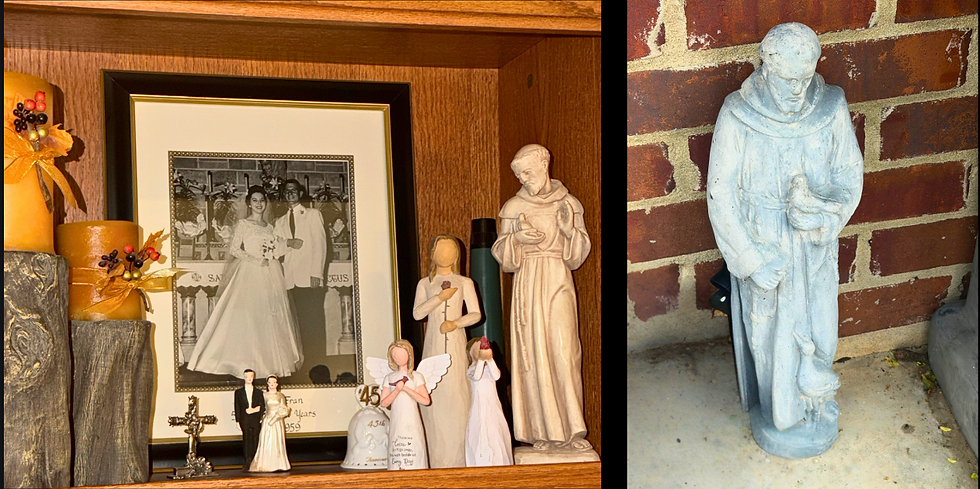
Marian devotion holds an equally important place within Sicilian religious life.
Mary has been honored throughout Sicily through shrines, processions, prayers, statues, candles, and devotion within the home. Her many titles often reflect the qualities people seek in her: mother, protector, comforter, and intercessor (Carroll, 1992; Warner, 1976).

One of Sicily’s best-known Marian devotions is the Black Madonna of Tindari, the Madonna Nera. Her image has been venerated at the Sanctuary of Tindari for centuries. Black Madonnas have a long history throughout Europe and the Mediterranean, with local traditions developing around individual images (Oleszkiewicz-Peralba, 2007).
Mary was also part of everyday life. Her images could be kept in homes alongside candles, flowers, prayer cards, and other sacred objects.
Carrying the Sacred
For Sicilian families, these devotions traveled.
Images of saints, medals, rosaries, prayers, candles, and other religious objects traveled with immigrants and became part of their religious lives in new communities (Orsi, 1985; Maselli & Candeloro, 2004).
My ancestors did not simply leave Sicily and arrive somewhere else. They carried culture, memory, food, language, beliefs, objects, and traditions with them.
Cefalù
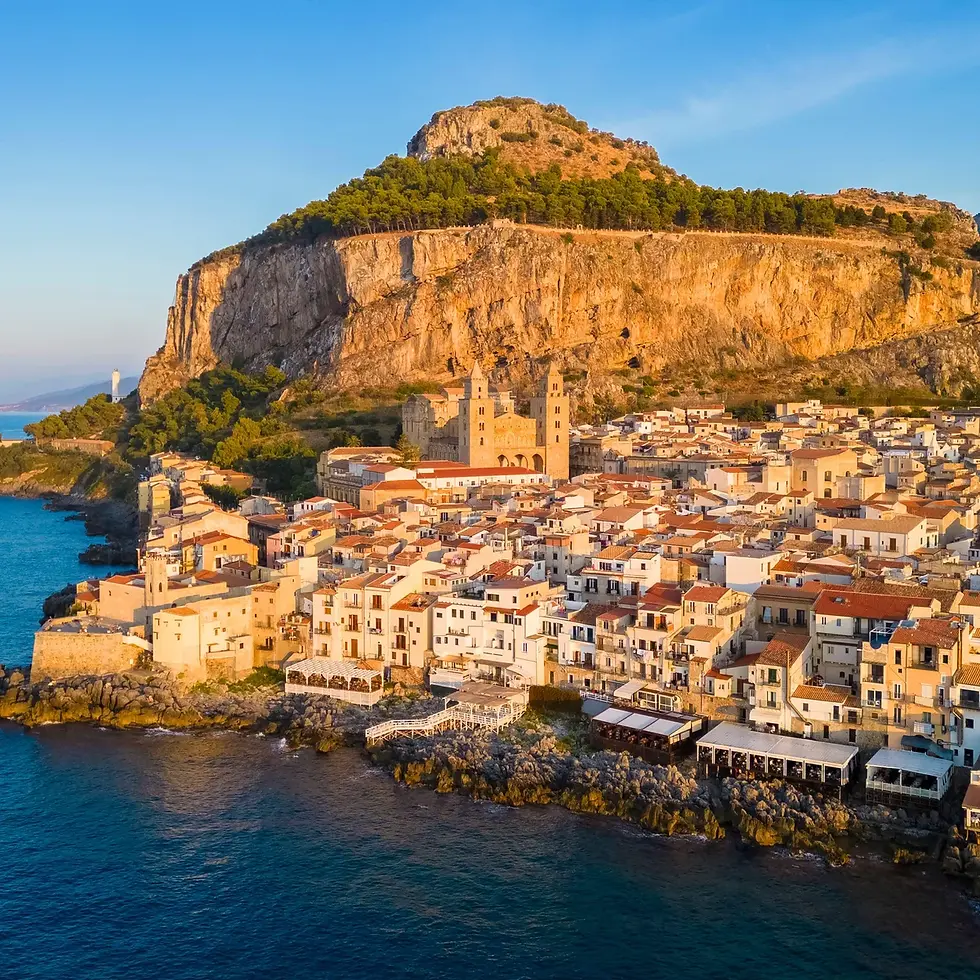
Cefalù is where my Sicilian story begins.
When I imagine my ancestors there, I picture the Mediterranean landscape, the churches and saints, the traditions of protection and blessing, the feast days, the family rituals, and the sacred objects that made faith part of everyday life.
I wonder what they saw when they walked through those streets.
What churches did they enter?
Which saints did they pray to?
What traditions did their families practice?
What did they carry with them when they eventually left?
I cannot recover every answer, but I can begin to understand the world they came from.
The Sicily I am searching for is the Sicily carried through memory, ritual, family, and faith. It is the Sicily that eventually crossed the ocean with my ancestors.
And if I want to understand where I come from, I have to follow them there.
_________
A Note on Sources
Because this essay is presented as a seven-part series, the complete reference list for sources cited throughout all seven parts will be included at the end of Part VII: Between the Old Ways and the Holy Ways.


Comments