
Chasing the Wild Goose

Updated: Oct 11
So, I did a thing.
I grew up Catholic. I was baptized, made my First Communion, and went to Catholic school. I knew all the prayers. I knew the Mass. Then I grew up, went in a million different spiritual directions, stopped believing, questioned basically everything, and eventually found myself sitting in a Catholic church again.
I think people might assume I came back because I started believing. That’s not really how I would describe it. I don’t have everything figured out, and my spirituality doesn’t fit neatly into a box. I just know that Catholicism has become the anchor in my search for meaning, connecting me to something larger than myself.
It connects me to my ancestry and helps me feel close to my grandparents who’ve passed. It gives me somewhere to put grief, fear, longing, and the things I can’t control. It brings me back to childhood and gives me a reason to slow down and pay attention. And honestly, I love the beauty of it too. The art, the symbolism, and the sense of history all speak to me. I know that might be surprising to hear from someone preparing for Confirmation, but it’s true.

During my Confirmation lessons, we talked a lot about the Holy Spirit. Father Dave Pivonka compares the Holy Spirit to “the wind that moves the sailboat” (Pivonka, 2019). Sometimes the Spirit comes as a whisper or a wail, as tongues of fire, as a feeling or a nudge, as deep peace or deep love.
The sacrament is centered on receiving the Holy Spirit and its gifts. In Catholic teaching, the fruits of the Spirit are the qualities that can grow in a person as they respond to the Spirit’s presence and work in their lives. They include love, joy, peace, patience, kindness, goodness, generosity, gentleness, and self-control, among other qualities (Catholic Church, 2005).
Saint Hildegard of Bingen wrote extensively about the Spirit, describing it through images of fire, breath, wind, water, light, and the life-giving greenness of creation. Her chants reflect these same images, including O ignis Spiritus paracliti, in which she describes it as a life-giving fire moving through creation. Hildegard also recorded her visions in Scivias, a collection of visionary writings accompanied by vivid illustrations. In it, she uses fire and light to describe the mystery of the Trinity, with fire representing the Holy Spirit (Hildegard of Bingen, 1990).

The Confirmation tradition includes choosing a patron saint, someone who serves as a spiritual guide, role model, and heavenly intercessor during the sacrament. Taking this name connects the person being confirmed with that saint and their example (United States Conference of Catholic Bishops [USCCB], 2006).
I chose Saint Brigid of Kildare.
Brigid is someone whose virtues I admire and want to emulate. She is traditionally said to have lived in fifth-century Ireland and founded a double monastery for women and men in Kildare, where she served as an abbess (Farmer, 2011). Kildare became an important Christian center, and Brigid is remembered as one of Ireland’s patron saints. Stories describe her as generous to the poor, welcoming to strangers, and devoted to healing and caring for others (Heritage Ireland, 2026). She is also the patron of poetry. I’ve been writing poetry since I was young, so that part of her story feels personal to me. She has been called “Mary of the Gael,” and hymns and poems about her go back centuries (Angel, 2021). Early Irish writers also composed poetry about her, including hymns about her life and virtues (Downey, 2015).
One of the earliest known written accounts of Brigid’s life and miracles is the Vita Sanctae Brigitae, written by Cogitosus around 650, more than a century after Brigid’s historical lifetime (Angel, 2021). The stories in this tradition emphasize not only Brigid’s faith, but her extraordinary generosity. She is said to have given away food and possessions to people in need and even miraculously turned water into beer for people suffering from leprosy (Angel, 2021).
One story says that Brigid made a cross from rushes while teaching a dying pagan chieftain about Christianity. Brigid’s Cross remains a Christian symbol associated with her feast day (Irish Catholic Bishops’ Conference, 2022). She is also closely linked with fire and light, including the sacred flame at Kildare that was tended by women of her community (Solas Bhride, n.d.).

Much of what we know about Brigid comes through hagiography, folklore, and later tradition, so it can be difficult to separate the historical woman from the stories that grew around her (Wycherley, 2026). But that uncertainty is part of her appeal. Her mystique embodies many of the qualities I associate with the Holy Spirit.
Brigid brings another side of my family into my spiritual life. She is Irish, and I have Scots-Irish ancestry on my mom’s side through my grandfather, my Papa Ralph. So much of my Catholic practice has become connected to my Sicilian heritage and the folk traditions I’ve been exploring on my dad’s side. In a way, Brigid brings those two sides of my family together, and that feels really special to me.

I’m particularly interested in the connection between Saint Brigid of Kildare and the pre-Christian Irish goddess Brigid, as well as how older traditions were carried into Christianity and took on new meanings. Later accounts of the goddess describe her as a triple figure, with three aspects tied to healing, smithcraft, and poetry. She was also connected to fertility, abundance, and protection. February 1 marks Imbolc, a pre-Christian festival celebrating the beginning of spring and associated with the goddess Brigid (Heritage Ireland, 2026).
The National Museum of Ireland describes St. Brigid’s Day, which is also celebrated on February 1, as a mix of Celtic ritual, Christian tradition, and folk customs. Some of these customs draw on older Celtic practices that became intertwined with the Christian feast day (National Museum of Ireland, 2023). What strikes me most is how little survives about the goddess in Irish mythology. One of the few stories that mentions her tells of her mourning the death of her son Ruadán. In Cath Maige Tuired, Brigid comes to mourn her son, first shrieking and then weeping. Her grief is described as the origin of keening in Ireland, a traditional form of mourning that could involve cries, lamentation, and improvised poetry (Gray, 1982).

Fire and flame are associated with both Brigid and the Holy Spirit. A hymn attributed to Saint Ultan of Ardbraccan describes Brigid as a “flame golden, delightful” and calls her “the branch with blossoms” and “one of the pillars of the Kingdom” alongside Saint Patrick (Angel, 2021). Brigid is associated with the sacred flame at Kildare, as well as with light, warmth, and healing. In Acts, the Holy Spirit appears as tongues of fire, an image that became an important Christian symbol of the Holy Spirit (Catholic Church, 2005).
Today, St. Brigid’s Cathedral stands on the site of the original monastery. The medieval flame associated with Brigid in Kildare was extinguished for centuries until the Brigidine Sisters relit it in 1993. A spark from that flame was later brought to Solas Bhride, where it has been tended ever since as a symbol of hope, justice, and peace (Solas Bhride, n.d.).

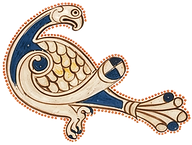
Birds offer another connection. Geese appear in some traditions of Saint Brigid’s iconography (Mehan, 2012), while the Holy Spirit is traditionally represented by a dove and is sometimes represented by a wild goose in Celtic Christian spirituality (Pivonka, 2019).
The Wild Goose is a very different image from the peaceful dove. It is noisy, unpredictable, and untamed. As an old Irish proverb puts it, “A wild goose never reared a tame gosling” (List of Proverbs, n.d.). That contrast is part of what makes the metaphor so interesting to me. The goose has a much older place in Christian symbolism. Medieval Christian writers distinguished between wild and domestic geese. Hugh of Fouilloy, a 12th-century French cleric, described wild geese as flying high in an orderly formation, associating them with people who lived righteously (Medieval Bestiary, n.d.). Father Rich Conlin makes the metaphor even more interesting by connecting the wild goose with the way the Holy Spirit appears at Pentecost. In his June 5, 2022 homily, he describes the Spirit as coming suddenly, with the sound of a rushing and violent wind. He connects that unpredictability with the way Celtic Christians understood the Spirit as something that could lead them into unexpected adventures. The phrase “the goose is loose” becomes a playful way of describing a Spirit that is moving and full of surprises (Conlin, 2022).

Part of what led me back to Catholicism was a longing to reconnect with the sense of awe I’ve felt throughout my life. Some of that comes from childhood memories, like attending St. John’s Cathedral in İzmir and visiting ancient ruins such as Ephesus. Those experiences shaped my love of art, history, architecture, and ritual. I found that same sense of wonder in churches, temples, mosques, and historic places throughout my travels growing up. Those experiences are what eventually brought me to Holy Trinity Catholic Church in Shreveport.

The architecture, stained glass, statues, and artwork at Holy Trinity speak to the part of me that is drawn to beauty, history, and symbolism. Construction of Holy Trinity began in 1896, and the church was designed in the Romanesque Revival style, known for its massive forms, rounded arches, and medieval-inspired details (National Park Service, 1984). The history of the church touches on many of the same themes I’ve been thinking about as I’ve returned to Catholicism. People have been coming into sacred places like this for generations, celebrating, grieving, praying, and facing their mortality.
During the yellow fever epidemic of 1873, Shreveport lost about a quarter of its population to the disease. Five Catholic priests died while caring for the sick and dying, including Father Jean Pierre and Father Isidore Quemerais. Both contracted yellow fever themselves and died within a day of each other. The five priests are commonly known as the Shreveport Martyrs and are currently recognized by the Church as Servants of God. Today, Holy Trinity, where Father Pierre served as founding pastor, is a Minor Shrine dedicated to their memory (Shreveport Martyrs, n.d.).

I’ve always been someone who feels things intensely: joy and grief, beauty and pain, love and loss. That intensity comes with a keen awareness of how fleeting life is. Memento mori. I’m fascinated by the fact that we are here at all, that we get to experience any of this for such a short amount of time. I grieve for our world, for conflict, for people I’ve lost, and for the past. I miss the safety of childhood, my family, and memories of attending Mass. I remember sitting in the pews, holding my dad’s hand and leaning against my mom’s shoulder, surrounded by the familiar sounds and rituals of the Mass.

What has changed is that I now have a spiritual practice that gives me a way to sit with some of those feelings. Through Catholicism, I have rituals, symbols, prayers, and devotions that help me hold the longing, grief, love, and awe. Lighting a candle, saying a prayer, attending Mass in a church filled with art and history, or receiving Communion all feel deeply meaningful to me.

There’s something profound in knowing Catholics all over the world are hearing the same readings and celebrating the Eucharist as part of the same liturgical tradition. I think that’s what I’ve been looking for when I talk about awe and wonder. The ritual and repetition connect me to generations of people who have come before me. That really moves me.
As I revisited Catholic Social Teaching, I noticed how much of it lines up with the way I already try to live. Mercy, grace, forgiveness, compassion, justice, and love all resonate with my understanding of the Spirit (USCCB, 2011). For me, those values move us toward compassion for others, a response to injustice, and care for people who are hurting.
I often tear up during Holy Communion. The first time it happened, it immediately reminded me of Bernini’s The Ecstasy of Saint Teresa, one of my favorite sculptures. Teresa describes an experience of being pierced by divine love, and Bernini somehow makes that feeling almost physical (Harris & Zucker, 2015). She looks overwhelmed by it, completely open to it.

My spiritual director told me there is a name for this: the gift of tears, a grace described in Catholic spiritual tradition as a profound sensitivity that can move a person to tears (Benedict XVI, 2010). The Latin word compunctio describes this kind of deep stirring of the heart, which can be expressed through tears (Francis, 2024). There is something strangely comforting about having a name for the way I sometimes experience spirituality. I think part of it is the empathy I feel for the world, but I also think it connects to that sense of awe I’ve been trying to describe. I’m deeply moved by the way art, music, ritual, history, and spiritual traditions can make the past feel a little closer to the present.
Standing in a candlelit church or hearing Gregorian chant, the mystery of why it hurts or heals is exactly what makes it so poignant. I don’t need to explain it at all. It is enough to let myself be moved.

P.S. I love that my Confirmation happened to fall on October 11, the feast day of Pope St. John XXIII and the anniversary of the opening of Vatican II in 1962. That makes me smile because so much of my own journey back to Catholicism has been about figuring out how tradition, change, and my questions can coexist.
____________________
References
Angel, M. (2021). Brigid: Goddess and saint. Evangelization & Culture: The Journal of the Word on Fire Institute, 6(2), 30–35.
Benedict XVI. (2010, November 24). General audience: Saint Catherine of Siena. The Holy See. https://www.vatican.va/content/benedict-xvi/en/audiences/2010/documents/hf_ben-xvi_aud_20101124.html
Catholic Church. (2005). Compendium of the Catechism of the Catholic Church. Libreria Editrice Vaticana. https://www.vatican.va/archive/compendium_ccc/documents/archive_2005_compendium-ccc_en.html
Cobb, D. (n.d.). Holy Trinity Catholic Church, Shreveport, Louisiana, signed and numbered art print [Watercolor painting]. Etsy. https://www.etsy.com/listing/1143314589/holy-trinity-catholic-church-shreveport
Conlin, R. (2022, June 5). [Homily] [Video]. YouTube. https://www.youtube.com/watch?v=m8ygxxie8ac
Downey, C. (2015). Literature and learning in early medieval Meath. In W. Nolan & A. Crampsie (Eds.), Meath history and society: Interdisciplinary essays on the history of an Irish county. Geography Publications. https://doi.org/10.13025/20070
Farmer, D. H. (2011). The Oxford dictionary of saints (5th ed., rev.). Oxford University Press.
Francis. (2024, October 24). Dilexit nos: Encyclical letter on the human and divine love of the Heart of Jesus Christ. The Holy See. https://www.vatican.va/content/francesco/en/encyclicals/documents/20241024-enciclica-dilexit-nos.html
Gray, E. A. (Ed. & Trans.). (1982). Cath Maige Tuired: The second battle of Mag Tuired. Irish Texts Society.
Harris, B., & Zucker, S. (2015, July 19). Gian Lorenzo Bernini, Ecstasy of Saint Teresa. Smarthistory. https://smarthistory.org/bernini-ecstasy-of-st-teresa/
Heritage Ireland. (2026, January). Brigit: The goddess and the saint. Office of Public Works. https://heritageireland.ie/2026/01/
Hildegard of Bingen. (1990). Scivias (C. Hart & J. Bishop, Trans.). Paulist Press.
Irish Catholic Bishops’ Conference. (2022). St. Brigid’s Day: February 1. https://www.catholicbishops.ie/2022/01/28/st-brigids-day-february-1/
List of Proverbs. (n.d.). Irish proverb. https://www.listofproverbs.com/source/i/irish_proverb/78283.htm
Medieval Bestiary. (n.d.). Hugh of Fouilloy, De avibus. https://www.medievalbestiary.info/manuscripts/manubeast4776.htm
Mehan, J. (2012). The search for San Ffraid [Master’s thesis, University of Wales Trinity Saint David]. https://repository.uwtsd.ac.uk/id/eprint/426/
National Museum of Ireland. (2023). St Brigid’s Day: A weaving tradition of Celtic rituals, Christian faith and enduring folk customs. https://www.museum.ie/en-IE/News/St-Brigids-Day-a-weaving-tradition-of-Celtic-ritu
National Park Service. (1984, September 27). Holy Trinity Catholic Church. National Register of Historic Places. https://npgallery.nps.gov/AssetDetail/aee7a76c-7360-4fa4-a874-9c6855ac60c8
Oliver, M. (1986). Dream work. Atlantic Monthly Press.
Pivonka, D. (2019). The Wild Goose [Video series]. 4PM Media.
Shreveport Martyrs. (n.d.). History. https://shreveportmartyrs.org/history/
Solas Bhride. (n.d.). The perpetual flame. https://solasbhride.ie/the-perpetual-flame/
United States Conference of Catholic Bishops. (2006). United States Catholic catechism for adults. United States Conference of Catholic Bishops. https://www.usccb.org/beliefs-and-teachings/what-we-believe/catechism/us-catholic-catechism-for-adults
United States Conference of Catholic Bishops. (2011). Themes of Catholic social teaching. https://www.usccb.org/resources/themes-catholic-social-teaching
VisaVisJewelryLA. (n.d.). Hand painted St Brigid goddess pendant [Hand-painted pendant]. Etsy. https://www.etsy.com/listing/1302197699/hand-painted-st-brigid-goddess-pendant
Wycherley, N. (2026, January 29). Will the real St Brigid please stand up? RTÉ Brainstorm. https://www.rte.ie/brainstorm/2026/0129/1349669-st-brigid-kildare-ireland-evidence-identity/


Comments